
Email Marketing vs Social Media Marketing: Which Drives Better ROI in 2026?
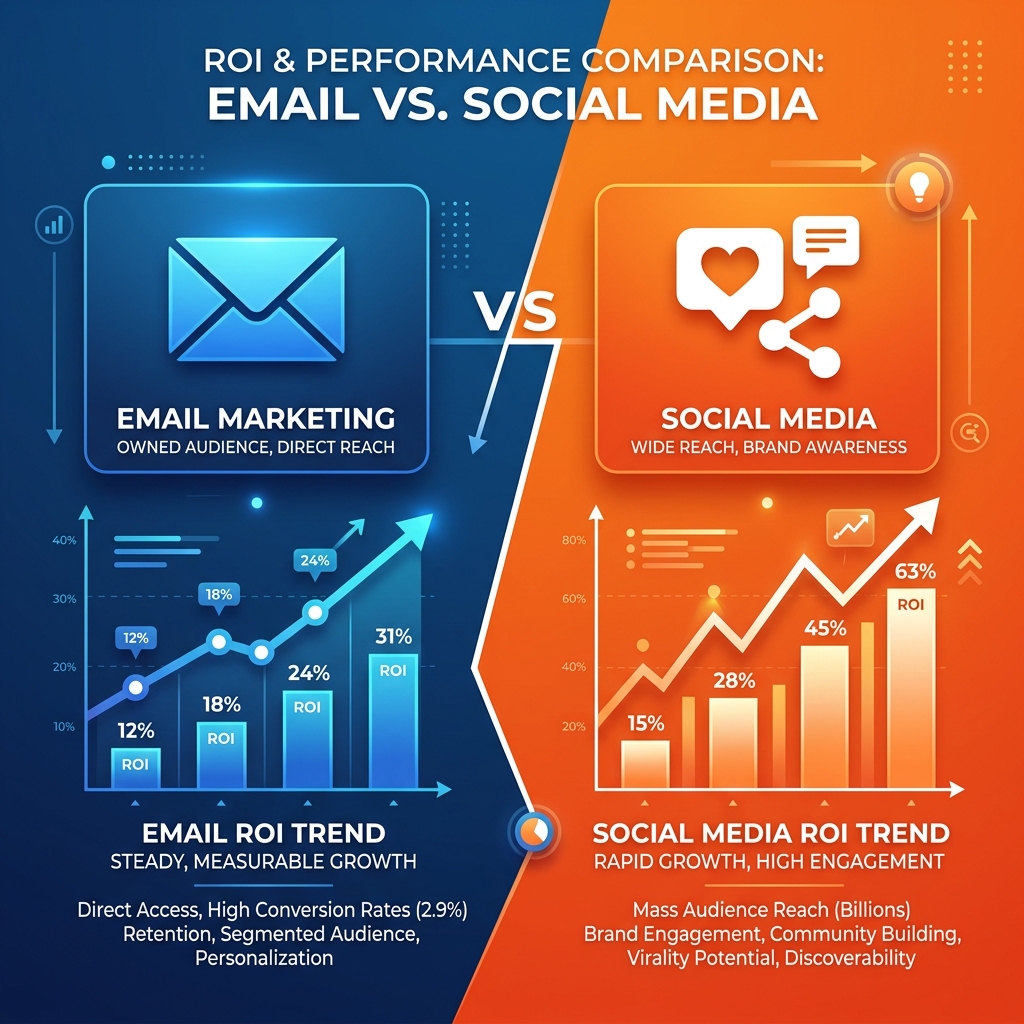
Digital marketing budgets in the United States are increasingly split between two dominant channels: email marketing and social media marketing. While social media dominates conversations and brand visibility, email marketing continues to outperform when it comes to return on investment (ROI), conversions, and customer retention.
But in today’s AI-driven marketing ecosystem, the real question isn’t simply which channel is better - it’s how each channel contributes to business growth and long-term revenue.
In this article, we break down the ROI, cost differences, conversion rates, and customer lifetime value between email marketing and social media marketing - while also examining how these channels perform in both US and Indian markets.
1. Cost Comparison: Email vs Social Media Marketing
For many businesses, especially startups and small companies, marketing budgets determine which channels they prioritize.
Email Marketing Costs
Email marketing is one of the most cost-efficient channels available. Typical costs include:
- Email automation software
- List-building tools
- Email copywriting and design
- Deliverability tools
On average, companies spend $51–$1,000 per month on email marketing platforms, depending on subscriber size and automation needs.
Social Media Marketing Costs
Social media marketing requires:
- Content production (graphics, video, copy)
- Social media management tools
- Paid advertising
- Community management
These costs typically range from $500 to $5,000 per month or more, especially when paid ads are included.
The Key Difference
Email marketing is owned media, meaning you control the audience list. Social media is rented media, meaning algorithms determine visibility. In fact, organic reach on many platforms is now extremely limited, often 2–4% per post, forcing brands to rely heavily on paid promotion.
2. Conversion Rates: Where the Real Revenue Happens
If ROI measures the outcome, conversion rate measures the efficiency of a marketing channel.
Email Marketing Conversion Rates
Email campaigns typically achieve conversion rates between 6–8%, depending on segmentation and targeting. Highly segmented campaigns can perform even better because subscribers already have existing interest in the brand.
Social Media Conversion Rates
Social media marketing generally produces 1–3% conversion rates, especially when targeting cold audiences. Users scrolling social platforms are typically in discovery mode, not buying mode.
Why Email Converts Better
Email recipients have already subscribed to your brand, shown interest in your content, and given permission to be contacted. This makes them far more likely to convert compared to users encountering a brand for the first time on social media.
3. ROI Comparison: The Numbers Tell the Story
One of the biggest reasons marketers continue investing in email marketing is the exceptional ROI.
Industry data shows:
- Email marketing ROI: around $36 for every $1 spent
- Social media ROI: roughly $2.80 for every $1 spent
Some high-performing email campaigns - especially in ecommerce - can generate $70+ ROI per dollar spent. This is why many US companies treat email as their primary revenue channel, while social media functions as the customer acquisition channel.
4. Customer Lifetime Value (CLV): Email’s Biggest Advantage
Customer lifetime value measures how much revenue a customer generates over time. Email marketing excels here because it enables businesses to:
- Send personalized offers
- Deliver lifecycle messaging
- Re-engage inactive customers
- Upsell existing buyers
Studies show that email marketing drives higher retention and repeat purchases compared to social media campaigns. Social media acquires customers; email marketing monetizes them.
5. The Impact of AI on Modern Marketing Channels
The marketing landscape in 2026 is heavily influenced by AI automation and machine learning tools.
AI in Email Marketing
- Automated personalization
- AI subject line optimization
- Predictive send times
- Behavioral segmentation
Interestingly, a recent study found that 87% of global email traffic is now generated by automated systems, highlighting how deeply automation is embedded in modern marketing strategies.
AI in Social Media Marketing
- Content generation
- Video editing
- Trend prediction
- Ad targeting
However, social media still relies heavily on platform algorithms, meaning brands cannot fully control their audience reach.
6. Case Study Example: SaaS Marketing Funnel
A typical SaaS marketing funnel often demonstrates how both channels work together:
- Awareness: Social media content generates brand awareness and traffic.
- Lead Capture: Visitors download resources or sign up for newsletters.
- Email Nurturing: Automated email sequences educate the prospect.
- Conversion: Email promotions or demos convert leads into paying customers.
7. How the Indian Market Compares
While the US market leads in marketing technology adoption, the Indian market has unique dynamics.
Social Media Dominance
India has extremely high social media usage, especially on Instagram, YouTube, WhatsApp, and LinkedIn (for B2B). Many brands prioritize social media because of lower entry barriers and viral reach potential.
Email Marketing Growth in India
However, email marketing adoption is growing rapidly in India for SaaS, EdTech, B2B services, and E-commerce brands. Indian startups increasingly use email automation to nurture leads generated from social platforms.
8. The Best Strategy: Integration, Not Competition
The real winners in digital marketing are not choosing between email and social media. They combine both.
- Social Media for: Brand discovery, community engagement, and content distribution.
- Email Marketing for: Lead nurturing, customer retention, and direct revenue generation.
Final Verdict: Which Channel Drives Better ROI?
If the goal is brand awareness, social media wins. If the goal is revenue and ROI, email marketing remains the clear leader.
The smartest strategy is to focus on building audiences on social media and converting them through personalized email marketing.
✅ At Five Digital Hawks, we help brands build full-funnel digital marketing strategies that combine:
- AI-powered email automation
- Social media growth strategies
- Lead nurturing funnels
- Performance marketing
The result? Higher ROI, better customer relationships, and scalable growth.